19th June 2009 - New research
LEWY BODIES FAIL TO INDICATE PARKINSON'S DISEASE
Journal of neuropathology and
experimental neurology [2009] Jun
16. [Epub ahead of print] (Markesbery WR, Jicha GA, Liu H, Schmitt FA.)
Complete abstract
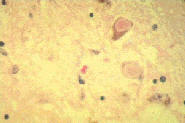
Lewy bodies are often claimed to be the hallmark of Parkinson's Disease. Lewy
bodies are basically rubbish bins in the nerve cells, that accumulate debris
caused by cell damage. For more information and links go to
Lewy Bodies.
It is claimed that Lewy Bodies can cause Parkinson's Disease by interfering with
the formation of dopamine, and also cause dementia by interfering with the
formation of acetylcholine. So researchers assessed the prevalence of Lewy
Bodies in people that did not have Parkinson's Disease or dementia, by
carrying out autopsies. None of the people assessed had Parkinson's Disease.
However, nearly a quarter of the brains were found to include Lewy Bodies in
various regions of the brain. This finding contradicts the assertion that Lewy
Bodies cause Parkinson's Disease,
because
so many people have Lewy Bodies without having Parkinson's Disease.
 It has also
been previously found that there are many people with Parkinson's Disease that
do not have Lewy Bodies either. The researchers still claimed Lewy Bodies "most likely represents preclinical or pre-symptomatic Parkinson
disease, Parkinson disease with dementia, or dementia with Lewy bodies."
However, their own findings contradict their own suggestion. Rather than Lewy
Bodies cause Parkinson's Disease, the results show that Parkinson's Disease, and
other medical disorders can sometimes cause Lewy Bodies.
For more current news go to
Parkinson's Disease News.
It has also
been previously found that there are many people with Parkinson's Disease that
do not have Lewy Bodies either. The researchers still claimed Lewy Bodies "most likely represents preclinical or pre-symptomatic Parkinson
disease, Parkinson disease with dementia, or dementia with Lewy bodies."
However, their own findings contradict their own suggestion. Rather than Lewy
Bodies cause Parkinson's Disease, the results show that Parkinson's Disease, and
other medical disorders can sometimes cause Lewy Bodies.
For more current news go to
Parkinson's Disease News.
E-MAIL NOTIFICATION : If you would like to be
notified by e-mail when any new research, news reports, new books, or new resources are
added to Parkinson's Disease News, please double click on
E-MAIL NOTIFICATION, or e-mail
[email protected]. No form of identity is required. E-mail addresses are
not used for any other purpose.
Parkinson's Disease News details all significant new research, news reports, new books, and new
resources concerning
Parkinson's Disease and those medical disorders that often coincide with Parkinson's
Disease. It is compiled from an analysis of all newly published research,
news reports, new clinical trials, all newly published books, and
new web sites. A summary and analysis of the new research are provided, as
well as links to the complete abstracts and news reports.






.gif)
.gif)